
INTERFACE REVOLUTION
Dreamforce 2026: How AIforce and Claudeforce Are Changing the Salesforce Experience
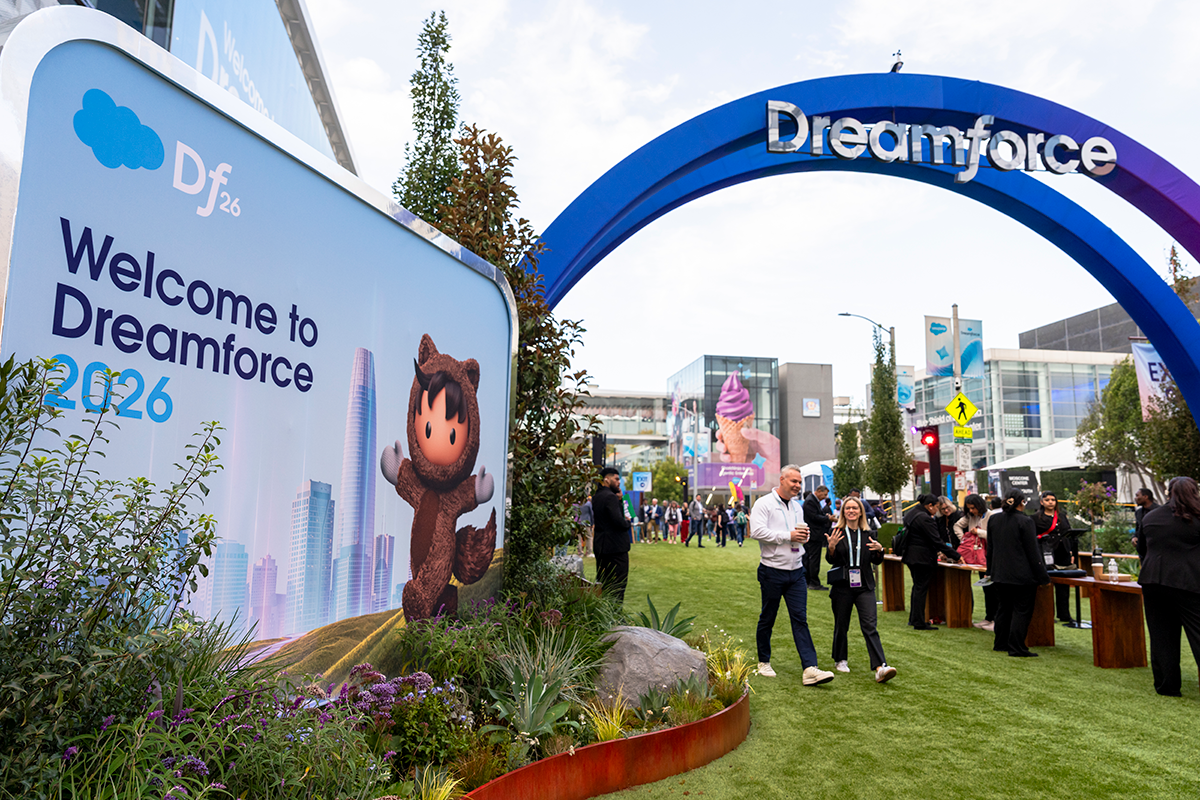
What if using Salesforce no longer required opening Salesforce? That idea was at the center of some of the biggest announcements at Dreamforce 2026.
Salesforce introduced AIforce, expanded its partnership with Anthropic through Claudeforce, and unveiled Koa, its first purpose-built CRM reasoning model developed with NVIDIA.
Behind these announcements is a much bigger idea:
AI is changing the way we interact with business software.
For decades, working with CRM meant opening an application, navigating dashboards, finding the right record, applying filters, updating fields, and moving between different screens.
AI introduces a more natural way to do the same work.
Instead of finding the right screen or report, users can simply explain what they need: “Which opportunities need my attention this week?”, “Prepare me for tomorrow’s meeting with this customer”, or “Show me which deals have had no activity in the last 30 days.”
An AI agent can understand the request, find the relevant Salesforce data, analyze it and help the user take the next step. This is the direction Salesforce presented at Dreamforce 2026.
AIforce: Salesforce comes to where you already work
One of the biggest announcements was AIforce. It makes Salesforce data, business processes, rules, and capabilities accessible through the tools and applications employees already use.
In simpler terms,
users no longer need to open Salesforce every time they want to access CRM data or complete a task. With the help of an AI agent, they can interact with Salesforce through tools such as Claude or Slack, while the same architecture creates the potential for future connections with other business and custom applications.
Imagine a sales representative who spends most of the day in Slack and wants to know which deals require attention. Traditionally, they might open Salesforce, navigate to their pipeline, apply filters, open several opportunities and review recent activity.
With AIforce, they could ask directly from the environment where they are already working: “Which of my deals need attention this week?” An AI agent can access the relevant Salesforce information, analyze it and provide an answer. The salesperson can then continue with “Create follow-up tasks for these three accounts,” and the agent can turn that request into an action in Salesforce.
This changes the way we interact with CRM.
The traditional experience follows a path from the user, through the Salesforce interface, to CRM data and processes.
With AIforce, an AI agent can become the interface between the user and Salesforce. Salesforce still powers the work, while AI provides a more conversational and intuitive way to access it.
Salesforce has introduced AIforce experiences across Claude, Slack, and Salesforce Lightning, giving users different ways to interact with CRM depending on how and where they work. Some may choose Claude, others may spend most of their day in Slack, while many will continue working directly in Salesforce with Agentforce Coworker in the Lightning experience.
And this could be just the beginning. As AIforce is designed as an interface-independent layer, the same approach could potentially extend to additional applications and custom interfaces in the future, bringing Salesforce data, workflows, and capabilities into even more of the tools businesses use every day.
And that is the central idea behind AIforce: Salesforce comes to where the user is already working.
➡️ Why is this such a big change?
Because it changes the way we interact with business software.
To get something done, we first need to understand how the software works. We need to know where the report is, which dashboard to open, where to find an account, which filters to apply and which fields to update.
AI changes that relationship. Users can increasingly focus on what they want to accomplish, while AI handles more of the navigation between data, tools and processes.
This is why Salesforce CEO Marc Benioff describes the current shift as an “interface revolution.” The interface itself is becoming intelligent, and Salesforce wants its CRM data and business processes to be available through that new interface.
➡️ What makes AIforce possible?
There is, of course, a lot of technology behind AIforce. One important part is Salesforce's Headless 360 architecture, but the concept behind it is simpler than the name suggests.
A Salesforce implementation contains much more than the screens users see. Behind the interface are customer records, sales processes, automation, approval rules, permissions, workflows and years of accumulated business logic.
Headless 360 lets you use those Salesforce capabilities from other interfaces.
Think of Salesforce as the engine. Traditionally, users accessed that engine mainly through the Salesforce application. Now, approved AI interfaces can connect to the same engine and use its capabilities.
The technology changes how users reach Salesforce, while the company's existing CRM foundation continues to power the experience.
And one of the clearest examples of what this looks like in practice is Salesforce's new partnership with Anthropic.
Claudeforce: combining Claude's intelligence with Salesforce context
Salesforce and Anthropic have expanded their partnership under the name Claudeforce. The first major product coming from this partnership is Salesforce in Claude.
To understand why this matters, it helps to look at what each side brings.
Claude is a powerful general-purpose AI model. It can understand natural language, analyze complex information, reason through problems and generate answers. Enterprise AI becomes even more useful when it also understands the company where it is being used, and this is where Salesforce comes in.
Salesforce contains the company's customers, accounts, opportunities, activities, sales processes and workflows. Put the two together, and you get a simple but powerful combination: Claude's intelligence + Salesforce business context.
Consider the difference between two questions. If you ask a general AI model “What are common signs that a sales deal is at risk?”, it can give you a useful answer based on general sales knowledge. If you ask “Which of my current deals need attention and why?”, the answer requires knowledge of your actual business.
Salesforce in Claude can use relevant CRM context to help answer that second question. An opportunity may still be open, for example, while its activity tells a more complex story. The close date may have changed several times, the customer may have stopped responding, or an important stakeholder may have disappeared from recent conversations.
Claude can look at those pieces of information together and help the seller understand what they could mean. That capability is called reasoning.
In everyday language, reasoning means that AI can look at several pieces of information, understand the relationships between them and use that context to reach a useful conclusion.
➡️ 37 ready-made sales skills inside Claude
Salesforce in Claude launches with 37 prebuilt sales skills created by Salesforce and Anthropic. A skill is essentially a task Claude has been specifically prepared to perform using Salesforce context.
One example is meeting preparation. A salesperson could ask, “Prepare me for my meeting with this account.” Claude can gather relevant customer and opportunity information and turn it into a useful briefing.
Another skill is deal health review. A seller can ask Claude to review an opportunity and help identify important signals around its progress. There is also pipeline review, allowing sellers to explore and analyze their pipeline through a conversation rather than relying exclusively on traditional reports and dashboards.
The experience becomes much more direct. Instead of opening different records, searching, filtering and manually connecting information, a seller can explain what they need and let AI help find and interpret the relevant context.
And then comes an even more important step: taking action.
➡️ From AI assistant to AI agent
We are already familiar with AI assistants that answer questions, summarize information and generate content. Agentic AI takes this further because an AI agent can also use tools and perform approved actions on behalf of the user.
Imagine that Claude analyzes a seller's pipeline and identifies three opportunities that require follow-up. The seller could then say, “Create follow-up tasks for these three opportunities,” and the request can be turned into an action inside Salesforce. After preparing for a customer meeting, the user could ask Claude to update the opportunity with the agreed next steps.
This is where AI starts to participate more actively in business processes. The experience evolves from simply asking a question and receiving an answer to a process of asking, reasoning and acting.
That is one of the central themes behind Salesforce's current AI strategy.
➡️ What about security?
This new way of working naturally raises an important question: if AI can access Salesforce, what can it actually see and do?
Salesforce is building AIforce around the permissions and business rules companies already have in Salesforce. Imagine two employees: one has permission to access the entire sales pipeline, while the other has access only to specific accounts. Their existing Salesforce permissions continue to determine what information and actions are available when they work through an AI interface.
The same principle applies when AI takes action. Actions are routed through Salesforce so the company's existing business rules can still be applied. This allows AI to work with valuable business context while Salesforce continues to provide governance around that context.
Salesforce is also emphasizing Zero Data Retention. In simple terms, when an external AI model processes Salesforce business data to answer a request, that data is not retained by the model provider after the interaction. This allows companies to combine external AI intelligence with business context while keeping enterprise data governance at the center of the experience.
READ MORE: Want to understand what agentic AI means for businesses? Explore our guide to agentic enterprise and the role of AI agents in everyday business processes.
Koa: an AI model built specifically for CRM
Dreamforce 2026 also brought another AI announcement: Koa, Salesforce's first purpose-built CRM reasoning model, developed with NVIDIA.
The easiest way to understand Koa is through specialization. Claude is a general-purpose AI model that can work across an enormous range of topics and tasks. Koa is designed specifically around CRM and enterprise workflows.
Its job is to understand the types of problems that happen inside customer relationship management, such as working with leads, opportunities, customer service cases and other business processes.
Salesforce trained Koa entirely on synthetic scenarios modeled on nearly three decades of CRM knowledge, covering real-world enterprise workflows across more than 14 industries. No customer data was used to train the model.
In simple terms, Claude is a powerful AI generalist, while Koa is being built as a CRM specialist. Both approaches can play a role in Salesforce's wider AI ecosystem.
What does all of this mean for Salesforce customers?
AIforce, Claudeforce and Koa point toward the same broader direction. The way we interact with CRM is becoming more conversational, contextual and intelligent.
Users can spend more time describing what they want to accomplish and less time navigating the technology required to accomplish it. Salesforce, meanwhile, continues to provide the customer data, processes, automation, permissions and business rules behind that experience.
For companies, this makes the quality of their CRM foundation increasingly important. AI agents work with the business context available to them, which means good customer data, clear processes, well-designed workflows and appropriate governance become essential parts of an AI-ready Salesforce environment.
IS YOUR SALESFORCE ENVIRONMENT READY FOR THE NEXT GENERATION OF AI?
At Kameleon Solutions, we help companies build Salesforce environments around their actual business processes, data, and goals, creating a strong foundation for AIforce, Agentforce, and the next generation of AI-powered business.
Talk to our Salesforce experts and find out how to prepare your CRM for what comes next.
The way we use CRM is changing.
Salesforce is bringing it closer to wherever work actually happens.